
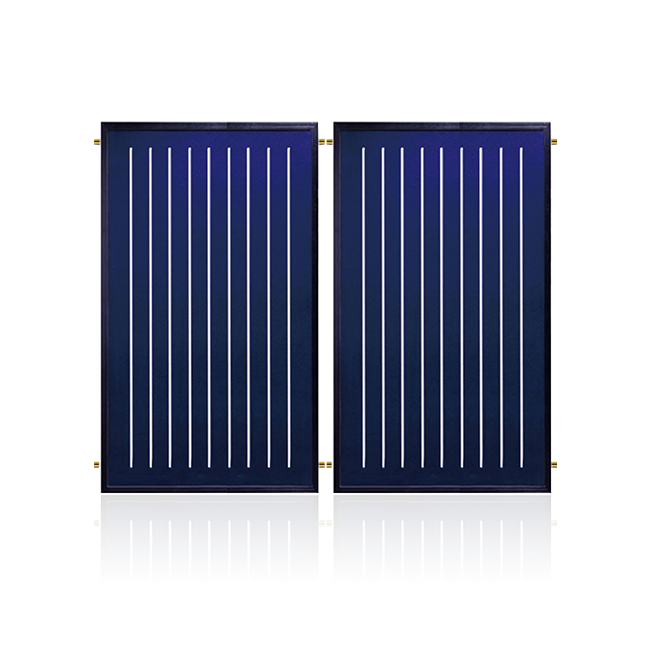
Flat panel solar collector efficiency is the key factor that determines how effectively a solar thermal system converts sunlight into usable heat.
The Significance of Calculating Flat Plate Solar Collector Efficiency
The thermal efficiency of a flat plate collector is the most important indicator of its performance.
Accurate efficiency measurement helps:
● Improve solar energy utilization
● Optimize building energy-saving strategies
● Compare different collector designs and materials
● Select the optimal configuration for real-world applications
Understanding efficiency is the foundation of designing high-performance solar thermal systems.
Main Methods for Calculating Solar Collector Efficiency
Different flat plate collectors use different light-transmitting insulation materials (tempered glass or PC sun board) and heat-exchange passages (single-layer or double-layer serpentine channels).
In this study, four collector types were tested:
● Type I: Tempered glass + serpentine single-layer passage
● Type II: Tempered glass + serpentine double-layer passage
● Type III: PC sun board + serpentine single-layer passage
● Type IV: PC sun board + serpentine double-layer passage
All collectors use a 1000×2000×1 mm aluminum absorbing plate coated with black paint and 50 mm insulation at the bottom.

Comparison Method
A contrast experiment was performed by placing two collectors side-by-side, ensuring identical ambient temperature, solar radiation, wind speed, and airflow rate. A forced air fan was used to maintain equal airflow across all collectors.
Data Measurement
Using temperature and airflow measurements, the following formulas were applied:
(1) Mass Flow Rate:
m = vFρ
(2) Heat Output:
Q = m Cp (tp – ta)
(3) Efficiency of the Collector:
η = Q / Qs
Where:
– m – mass flow rate
– Q – heat output
– v – average airflow velocity
– F – cross-section area
– ρ – air density
– Cp – specific heat of air
– tp – outlet air temperature
– ta – inlet air temperature
– Qs – solar heat input
Interpretation of Results
Under equal solar radiation, the collector with the higher outlet-air temperature delivers more heat and therefore has a higher efficiency.
Comparing outlet temperatures makes it possible to determine which collector structure performs best.
Pros and Cons of the Measurement Method
Advantages:
● Environmental conditions are consistent for both collectors
● Multiple controlled comparisons ensure reliable data
● Individual structural factors can be evaluated accurately
● Results help determine the optimal flat plate collector design
Disadvantages:
● Weather variations significantly affect measurement accuracy
● Winter testing produces insufficient solar radiation
● Summer testing can be disrupted by wind, clouds, rain, or storms
● Long-term outdoor testing is required for stable results
Conclusion
Through controlled comparison experiments, this method effectively evaluates the efficiency of flat plate solar collectors. The results can guide users and engineers in selecting the best-performing collector type for their needs.
FAQs:
1: What is flat panel solar collector efficiency?
Flat panel solar collector efficiency refers to how effectively the collector converts incoming solar radiation into usable thermal energy. Higher efficiency means more heat output for the same amount of sunlight.
2: How is the efficiency of a flat panel solar collector calculated?
Efficiency is typically calculated using the formula η = Q / Qs, where Q is the heat output of the collector and Qs is the amount of solar heat received. Temperature difference, airflow, and solar radiation are key factors in the calculation.
3: What factors affect the efficiency of flat panel solar collectors?
Efficiency can be influenced by the transparency of the cover material, absorber coating quality, insulation thickness, ambient temperature, wind speed, and the design of the heat-transfer channel.



Leave A Comment
Your email address will not be published.